
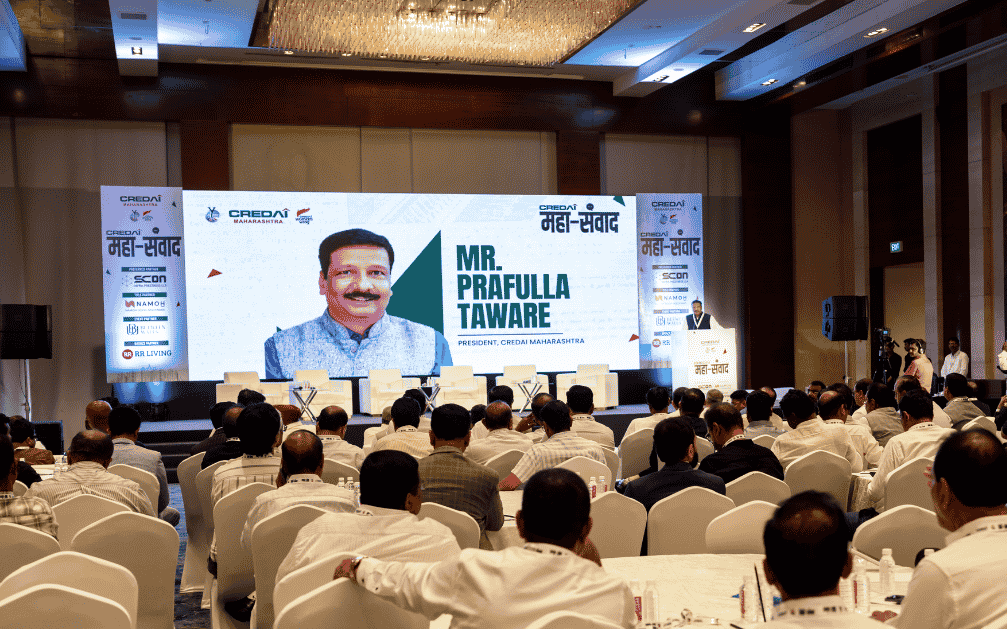
PUNE — In an effort to streamline statutory bottlenecks and accelerate approvals across the state’s property markets, CREDAI Maharashtra convened its apex annual consultative forum, the CREDAI Maharashtra Managing Committee & CREDAI Maha Samwad Meeting 2026, in Pune.
The day-long conclave brought together more than 300 real estate developers representing 45 tier-1, tier-2, and emerging cities across Maharashtra for intensive, department-level deliberations with senior bureaucratic leadership.
Rather than functioning as a standard industry conference, the summit served as a bilateral problem-solving mechanism. State administrative bodies presented current technological frameworks and operational rollouts, followed by structured grievance redressal sessions addressing systemic hurdles in project licensing, land mutations, and digital compliance.
Tackling the MahaRERA 2.0 Transition and Project Compliance
A central focal point of the discussions was the administrative and operational migration of ongoing real estate developments from MahaRERA 1.0 to the upgraded MahaRERA 2.0 digital architecture.
Developers raised practical challenges regarding technical portal glitches, document requirements for rectifying project data, and procedures for updating Occupancy Certificates (OC). Developers also discussed the procedural rigidity associated with Quarterly Progress Report (QPR) submissions and project completion disclosures.
Key regulatory interfaces reviewed during the summit included:
- MahaRERA Portal Transitions: Resolving migration bugs and establishing pragmatic timelines for compliance disclosures.
- Unified Development Control and Promotion Regulations (UDCPR): Removing interpretive ambiguities across municipal corporations and local town planning authorities.
- Building Plan Management System (BPMS): Addressing duplication between automated online approvals and redundant physical document submissions.
- Deemed Conveyance Protocols: Instituting legal mechanisms to execute title transfers where developers are willing to comply but face non-cooperation from cooperative housing society management.
Land Records, ASR Valuation, and Revenue Alignments
The forum also addressed revenue administration, stamp duties, and land registration. Developers met with leadership from the Inspectorate General of Registration (IGR) and the Directorate of Land Records to flag operational friction points.
A primary issue raised was the interpretation of footnotes under the Annual Statement of Rates (ASR), which directly dictates stamp duty valuations, joint development viability, and land acquisition feasibility. Inconsistencies in ASR interpretations often trigger arbitrary revenue assessments, leading to prolonged commercial delays.
Discussions with revenue commissioners centered on digitizing land governance through the e-Ferfar system, standardizing 7/12 land extract updates, and streamlining post-sale deed mutation entries to protect both promoter viability and buyer equity.
Prafulla Taware, President of CREDAI Maharashtra, highlighted the necessity of institutional transparency:
“Continuous, transparent and positive dialogue between the government and developers is essential for the overall development of the real estate sector. Through the Maha Samwad, practical issues can be placed directly before the concerned officials, providing a direction towards finding workable solutions.”
Ashish Pokharna, Honorary Secretary of CREDAI Maharashtra, added that direct bureaucratic engagement helps build administrative predictability, transparency, and investor confidence across regional urban corridors.
With Maharashtra experiencing rapid urban expansion beyond the Mumbai Metropolitan Region (MMR) and Pune into secondary growth centers, industry stakeholders emphasized that aligning town planning authorities with real estate operational realities is critical to sustaining regional infrastructure and housing delivery.