
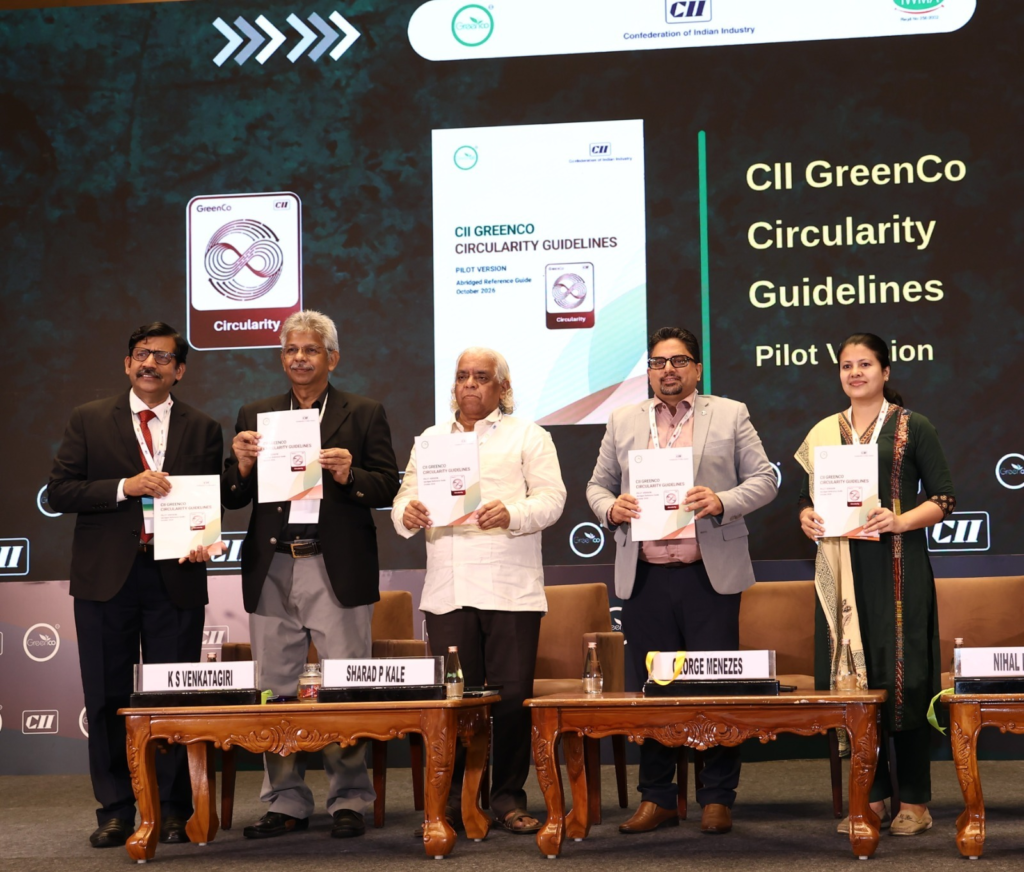
CHENNAI — The Confederation of Indian Industry (CII) GreenCo Council has officially launched the “CII GreenCo Circularity Guidelines – Pilot Version” at the 17th edition of the CII GreenCo Waste & Resource Management Summit 2026 in Chennai. Organized under the theme “Accelerating Circular Economy through Resource Efficiency & Innovation,” the summit convened policymakers, industry executives, technology specialists, and sustainability practitioners to accelerate circular practices across Indian industrial sectors.
The newly unveiled framework introduces circularity indices designed to evaluate resource inputs across manufacturing and process facilities, covering critical areas such as raw materials, consumables, and packaging. As heavy resource-consuming sectors confront the imperative to cut waste, optimize input productivity, and lower environmental footprints, the guidelines establish a structured diagnostic mechanism, a credible certification pathway, and measurable performance benchmarks.
Setting Metrics for Industrial Resource Use
Addressing delegates at the summit, Padma Shri Dr. Sharad P. Kale, Special Advisor to the Chief Minister, Government of Goa, and former scientist at Bhabha Atomic Research Centre (BARC), stressed that systemic circularity must stem from responsible resource stewardship.
“Circularity must begin with a fundamental change in how we view and manage resources. While technology and policy have important roles to play, every individual must recognize the need to reduce waste at source and make circularity a way of life,” Dr. Kale stated. “Responsible consumption, resource conservation and waste reduction must become integral to our daily practices, as well as to the way industries operate.”
George Menezes, Adviser – Sustainability at Godrej Enterprises Group, highlighted the necessity of standardized metrics to facilitate industrial transitions:
“Manufacturing and process industries need a common framework that can help them assess their current practices, identify improvement opportunities and measure progress towards circular resource use. A well-defined certification mechanism can further encourage accountability, consistency and continuous improvement. I urge industries to participate in the pilot, apply the guidelines within their operations and share feedback to help strengthen the framework for wider industry adoption.”
Deepening Decarbonisation and Resource Efficiency
K. S. Venkatagiri, Executive Director at the CII Green Business Centre, noted that the pilot expands upon CII GreenCo’s established rating and certification mechanisms:
“From the GreenCo Rating System to Zero Waste to Landfill and Zero Liquid Discharge certifications, these initiatives have helped companies strengthen their sustainability practices and pursue measurable environmental improvements,” Venkatagiri said. “The launch of the CII GreenCo Circularity Guidelines – Pilot Version builds on this journey by addressing the growing need to embed circularity into industrial operations.”
The framework arrives as industrial ecosystems grapple with intensive raw material, energy, and water demands. To refine the guidelines for scale, CII GreenCo has invited manufacturing and process enterprises to deploy the pilot across operational sites and submit operational feedback.
Technological Pathways and Circular Ecosystems
Beyond the guideline rollout, the summit hosted dedicated sessions on “Waste to Wealth: Building India’s Circular Manufacturing Ecosystem,” exploring strategies around industrial symbiosis, closed-loop process design, and value-chain integration.
Technical discussions focused on:
- Advanced Processing: Mechanical, chemical, biological, and thermal recycling technologies.
- Clean Fuel and Specialty Streams: Biogas, Bio-CNG/CBG, waste-to-energy pathways, e-waste, electronics, and battery recycling.
- Digital Infrastructure: Applications of artificial intelligence, smart sensors, automation, and digital traceability to improve industrial sorting, segregation, and recovery systems.
GreenCo’s Industrial Footprint
The CII GreenCo Council’s broader initiatives have seen participation across 750 rated facilities, generating verified resource and cost efficiencies:
- Energy Savings: 650 million units of electrical energy and 362 million units of thermal energy saved annually.
- Renewable Additions: 21.16 GW added.
- Decarbonisation: 6 million metric tonnes of CO₂ equivalent (tCO₂e) in greenhouse-gas mitigation.
- Resource Preservation: 200 million kilolitres of water conserved and 0.35 million tonnes of waste diverted from landfills.
- Capital Outlay & Returns: Supported by approximately ₹5,900 crore in green investments, yielding ₹5,450 crore in recurring annual monetary savings.
Industrial players seeking to trial the pilot framework or submit technical inputs can connect directly with the CII GreenCo Council.